
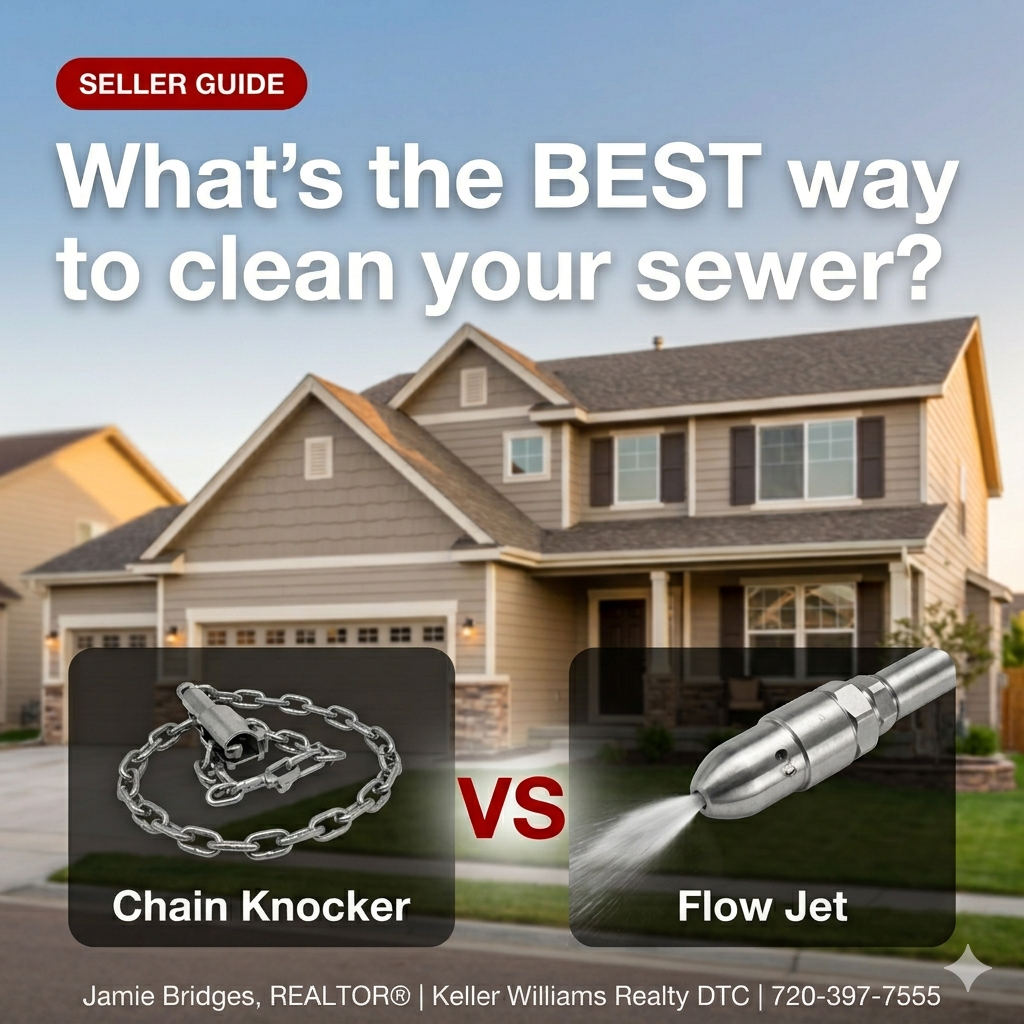
Should you clean your sewer line before selling your home? Yes, and the method matters. Chain knocking and hydro jetting (flow jet) each work differently, and choosing the right one can save you money and prevent surprises during the inspection period.
If you're getting ready to list your home in the Denver Metro Area or Summit County, Colorado, a sewer scope inspection is one of the smartest pre-listing steps you can take. And if your line needs cleaning first, you'll likely hear two options: chain knocking or flow jetting. Most sellers don't know the difference until they're standing in their driveway with a plumber explaining it. Here's what you need to know before you get there.
Why the Sewer Line Matters When You're Selling
Buyers in today's market are thorough. A sewer scope inspection, where a camera is run through the line from the cleanout to the city main, has become a routine buyer request, especially on homes built before the 1980s. What shows up on that camera can directly affect your sale.
A line with root intrusion, grease buildup, offset joints, or debris can give a buyer reason to renegotiate or walk away entirely. Getting ahead of that with a pre-listing inspection puts you in control. If something's there, you know about it first, and you can decide how to handle it on your terms, not under contract pressure.
Chain Knocking: The Mechanical Approach
Chain knocking (also called chain cutting or mechanical descaling) uses a rotating chain flail that spins inside the pipe at high speed. The chains strike the pipe walls, breaking apart hardened scale, mineral deposits, and light root intrusion.
When it works well
- Older pipes with calcium or mineral buildup (common in Denver Metro areas with hard water)
- Lines with hardened scale that water pressure alone can't dislodge
- Situations where the buildup is more structural than organic
Potential drawbacks
- More aggressive on older or fragile pipes. Cast iron, clay tile, and Orangeburg pipes that are already compromised can be further damaged by the mechanical impact.
- Generally not effective against heavy grease or soft organic debris.
- May require a scope before and after to confirm results and check for damage.
Flow Jet (Hydro Jetting): The High-Pressure Water Approach
Hydro jetting uses a specialized nozzle and a high-pressure water stream, often exceeding 4,000 PSI, to blast debris, grease, roots, and buildup out of the pipe and toward the city main. It's thorough, fast, and leaves the interior of the pipe significantly cleaner than mechanical methods.
When it works well
- Grease accumulation, which is especially common in older kitchens with cast iron drain lines
- Soft root intrusion in the early stages
- General maintenance cleaning before a scope or listing
- Newer or structurally sound pipes that can handle the pressure
Potential drawbacks
- Not recommended for pipes that are already cracked, severely offset, or deteriorating. High pressure can worsen existing damage.
- Costs more than mechanical cleaning in most cases.
- If roots are mature and thick, hydro jetting may clear them temporarily but not eliminate the source. A follow-up scope will confirm whether the root intrusion requires repair.
Which Method Is Right for Your Home?
The honest answer is that neither method is universally better. It depends on what's in the pipe, the pipe material, the pipe age, and what a qualified plumber finds during the initial scope.
A good plumber will scope the line first, identify the type and severity of the buildup, and recommend the appropriate cleaning method. Be skeptical of anyone who recommends a cleaning method before they've looked inside the pipe.
Here's a simple way to think about it:
| Condition | Recommended Approach |
|---|---|
| Mineral scale, hard deposits | Chain knocking |
| Grease, soft debris | Hydro jetting |
| Light root intrusion | Hydro jetting (with follow-up scope) |
| Heavy root intrusion | Mechanical removal + possible repair |
| Unknown / first-time scope | Scope first, then decide |
The Pre-Listing Case for a Sewer Scope
Even if you've never had a slow drain or a backup, your sewer line can have issues you'd never notice from inside the house. Tree roots grow toward water. Older clay tile lines crack and shift over decades. Lines in Summit County properties, especially those with high seasonal occupancy or vacancy, can collect sediment over time.
Getting a sewer scope done before you list does three things:
- It tells you whether you have a problem before a buyer's inspector finds it.
- It gives you documentation you can share with buyers to build confidence in the home's condition.
- If cleaning is needed, you can get it done at your pace, with your chosen plumber, at a fair market price, rather than scrambling mid-contract.
Sellers who go into the process prepared almost always have smoother transactions. A sewer scope typically costs between $150 and $350 depending on your area and the scope of work. It's a small investment relative to what it can save you.
Frequently Asked Questions
Do buyers always request a sewer scope inspection in Colorado? Not always, but it's increasingly common, particularly on older homes and in areas with mature trees. In the Denver Metro Area, buyers on homes built before 1980 often request a sewer scope as a standard part of their due diligence. Doing it pre-listing removes the uncertainty.
Can a failing sewer line kill a sale? It can complicate one significantly. A line with severe root intrusion, a collapsed section, or an offset joint will come up on a buyer's inspection report. Depending on severity, buyers may request repairs, a price reduction, or a credit at closing. Having the information before listing means you choose how to respond.
How often should a sewer line be cleaned? For most residential properties, every three to five years is a reasonable maintenance interval, though this varies based on tree coverage, pipe age, and usage. Homes with large trees in the yard or older clay tile lines may benefit from more frequent attention.
Thinking About Selling?
Preparation is what separates a smooth sale from a stressful one. A sewer scope is one of the lower-cost, higher-impact things you can do before your home hits the market.
Jamie Bridges is a REALTOR® with Keller Williams Realty DTC serving the Denver Metro Area and Summit County, Colorado. If you're thinking about selling and want a realistic picture of what to expect and how to prepare, call or text Jamie at 720-397-7555.
Check out this article next