
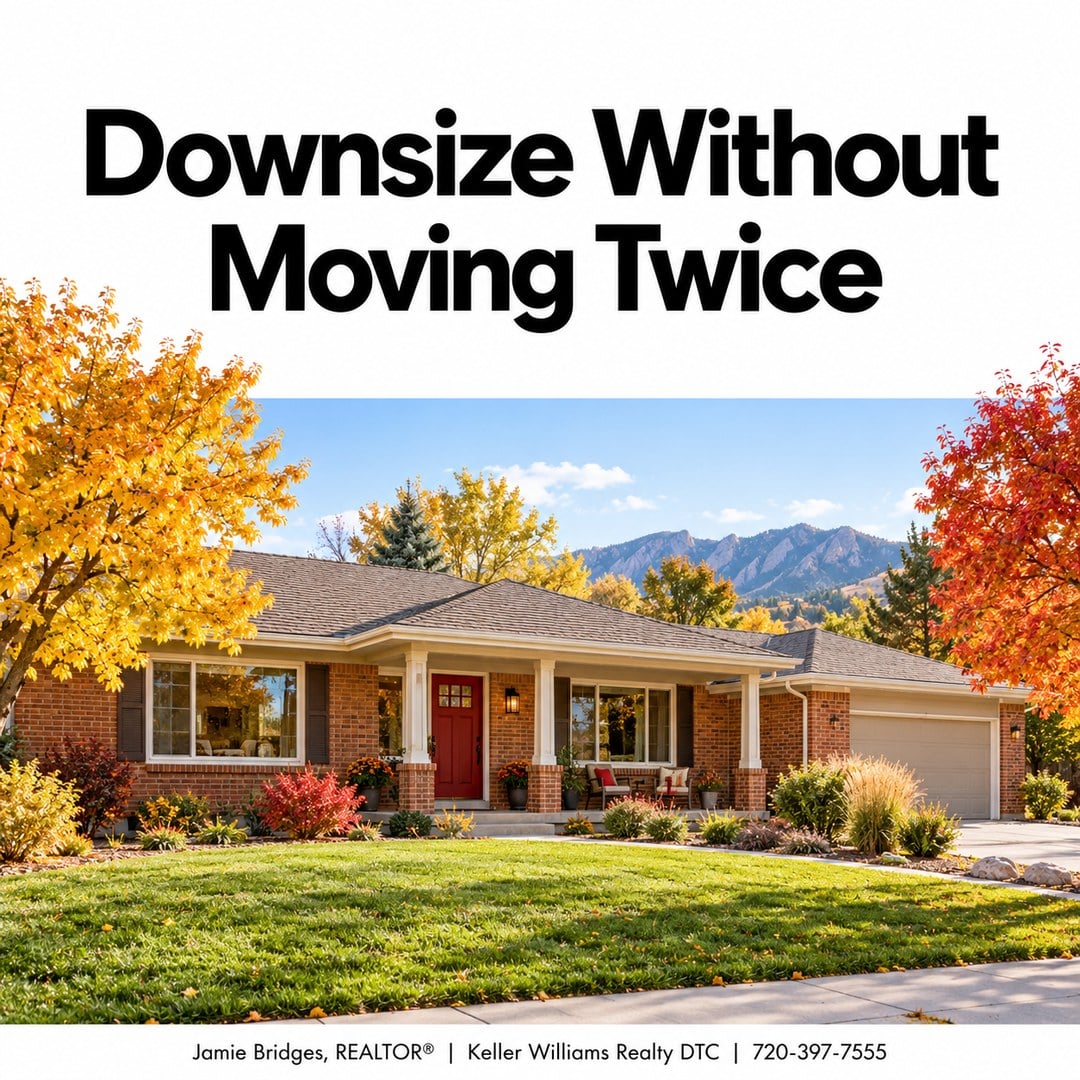
How do you downsize from a large home in Centennial or Littleton without moving twice?
Pick the next home's must-haves before you list, then use the Colorado contract to line up both moves. For South Denver downsizers in Centennial and Littleton, the order decides whether you move once or twice.
Picture the house you've owned in Centennial for 20 years. Four bedrooms upstairs, two of them mostly storage now. A basement full of furniture that hasn't moved since the last remodel. You know the next place should be smaller, maybe with the primary bedroom on the main floor. What stops most people is the order: sell first and you might need a rental in between, buy first and you're carrying two homes.
There's also a number many South Denver Metro downsizers don't know about. If you've received Colorado's Senior Property Tax Exemption, a move used to mean losing it. Under the Qualified Senior Primary Residence Classification, owners who received the exemption as of January 1, 2020 or later and then moved can apply for the same reduction on the new home: 50% of the first $200,000 of actual value isn't taxed.
This post lays out a sequence that keeps you to one move, the contract tools that make it work, and the money checks to run before you list.
Start With the Next Home
It's tempting to begin with the listing. For a downsizer, the better first step is a clear picture of where you're going, because that decides how much time you need between the two closings.
Write down what the next home has to have. In Centennial, Littleton, Highlands Ranch, and the rest of the South Denver Metro, downsizers often look at:
- Ranch homes with the primary bedroom and laundry on the main floor
- Patio homes and townhomes where the HOA handles snow removal and yard work
- Condos with an elevator and less exterior upkeep
Each comes with trade-offs. An HOA that clears your walk also brings monthly dues and rules. A ranch home on its own lot gives you a yard to maintain. Decide which trade fits before you're under contract on the house you're selling.
Then tour a few homes in the category you've chosen. You're not buying yet. You're finding out what your budget gets you and how long homes in that segment are taking to sell.
Three Ways to Sequence the Move
Sell First, Then Stay With a Rent-Back
You list, accept an offer, and negotiate to stay in the house for a period after closing. The Colorado contract handles this through a Post-Closing Occupancy Agreement, checked in Section 31.1.1 of the Colorado Real Estate Commission's residential contract. When the parties sign one, it controls the possession date.
This gives you your sale proceeds and a known budget before you buy, with time to close on the next home without a rental in between. The length of the stay and any rent are negotiated with the buyer.
Buy First With a Contingent Offer
Section 10.7 of the same contract lets you make your purchase "conditional upon the sale and closing" of your current home, with a Conditional Sale Deadline. If your home hasn't sold and closed by that date, you can terminate.
Sellers weigh contingent offers against non-contingent ones, so this option works best when your current home is ready to list right away and priced to draw buyers from the first weekend.
Sell First and Rent in Between
This is the move-twice option. It gives you the most flexibility on the next purchase and the most disruption in your life. For a downsizer with decades of belongings, two moves usually means two rounds of packing and two sets of moving costs.
Give Yourself a Runway
Downsizing takes longer than a typical sale because the sorting comes first. A workable plan:
- Sort before you stage. Decide what goes to the new home, what goes to family, and what gets sold or donated. Measure the rooms in the type of home you're moving to.
- Handle repairs and pre-listing prep once the house is lighter. Buyers can see the rooms better, and so can the inspector.
- Build in market time. In September 2026, the median Denver Metro home spent 33 days in the MLS, up from 15 in April, according to REcolorado's monthly housing market reports. Your timeline should allow for that range.
Starting the sort two or three months before listing keeps the decisions from piling up in the final weeks.
Run the Money Checks Before You List
Property Taxes on the Next Home
Colorado's Division of Property Taxation announcement for the 2026 to 2027 classification explains who qualifies: an owner who received the Senior Property Tax Exemption as of January 1, 2020 or later and lost it because of a move to a new primary residence. There are no income limits. Applications go to the county assessor by March 15, and late applications are accepted until July 15, though late filers lose the right to appeal a denial.
If you've never had the senior exemption, the standard rules still apply: age 65 or older and 10 consecutive years of owning and occupying the home as of January 1 of the application year.
Capital Gains on the Sale
If you've owned your South Denver Metro home for decades, you may have significant equity. Federal tax law lets many homeowners exclude up to $250,000 of gain, or $500,000 for married couples filing jointly, on the sale of a main home they owned and lived in for at least two of the last five years. IRS Topic 701 covers the rules. Talk with your CPA about your own numbers before you list.
Carrying Costs in the Next Home
Compare HOA dues, insurance, and utilities on the smaller home with what you pay now. A lower price doesn't always mean a lower monthly cost.
Jamie Bridges, a REALTOR® with Keller Williams Realty DTC, works with downsizing homeowners across Centennial, Littleton, Highlands Ranch, and the rest of the South Denver Metro. He holds the Seniors Real Estate Specialist (SRES) designation, and with every downsizing client he maps the next home and the sequence of both closings before the current house goes on the market.
Frequently Asked Questions
Can I keep my Colorado senior property tax exemption if I downsize? You may qualify for the same reduction on your new home. Colorado's Qualified Senior Primary Residence Classification applies to owners who received the Senior Property Tax Exemption as of January 1, 2020 or later and lost it because they moved. You apply through your county assessor.
Can I stay in my house after closing when I sell in Colorado? Yes, if the buyer agrees. The Colorado residential contract includes a Post-Closing Occupancy Agreement option in Section 31.1.1, and when it's signed, it sets the possession date. The length of the stay and any rent are negotiated.
Do I pay capital gains tax when I downsize? Many homeowners can exclude up to $250,000 of gain, or $500,000 for married couples filing jointly, if they owned and lived in the home for two of the last five years. Your CPA can confirm how it applies to you.
If you're planning a downsize in Centennial, Littleton, or anywhere in the South Denver Metro, start with the next home and the sequence. Jamie Bridges is a REALTOR® with Keller Williams Realty DTC serving the Denver Metro Area and Summit County, Colorado. Call or text Jamie at 720-397-7555 to talk about your next move.
Sources: Colorado Governor's Office release on the 2026 to 2027 Qualified Senior Primary Residence Classification, March 5, 2026; Adams County Assessor senior exemption eligibility page; Colorado Real Estate Commission Contract to Buy and Sell Real Estate (Residential), version for use on or after January 1, 2026, Sections 10.7, 17, and 31.1.1; REcolorado Housing Market Report, September 2026 (published October 7, 2026); IRS Topic 701. Data deemed reliable but not guaranteed. General information only. This isn't legal or tax advice.
Check out this article next